"I perceive, then I reason, then I decide, then I act, and then, because no one wrote a stopping condition, I perceive again. I have been very productive this afternoon. I have also been doing exactly the same thing for six hours."
An Agent That Perceives, Plans, and Acts, and Occasionally Loops Forever
An agent is the loop made flesh. Every preceding chapter of this book gave you a piece: a model that perceives a stream of observations, an estimator that reasons about hidden state, a policy that decides, an action that changes the world, and a world that answers back at the next timestep. An agent is the running program that wires those pieces into a single cycle, perceive then reason then decide then act, and runs it forward through time. This section is where the book's two great arcs converge. The temporal-modeling arc of Parts I through V taught a system to perceive and predict; the sequential-decision arc of Part VI taught it to decide and act under consequence. An agent is their composition: a perception-and-reasoning core sitting inside a decision-and-action loop, carrying state across time. We define the temporal agent precisely as a recurring perceive-reason-decide-act cycle, survey the architecture families that have implemented that cycle (classic sense-plan-act and subsumption from robotics, reactive RL policies from Part VI, and the LLM-based ReAct agents that now dominate practice), lay out the modern LLM-agent stack of a policy core plus memory plus planning plus tools, catalogue the failure modes that make agents loop forever or drift off course over long horizons, and finally build a minimal ReAct agent from scratch before collapsing it into a library skeleton. You leave able to read any agent framework as one instance of a single loop, and to reason about where that loop will break.
Every system in this book has been, secretly, a fragment of an agent. Back in Section 1.3 we drew the perceive-reason-decide-act loop as the defining shape of temporal intelligence and promised it would return as a running program; this is where that promise is kept. In Chapter 22 we formalized the agent-environment loop of a Markov decision process: an agent observes a state, selects an action, and the environment returns a reward and a next state, around and around. An agent architecture is what you get when you stop treating that loop as a mathematical abstraction and start treating it as code that runs, with a perception module, a reasoning core, a decision rule, an action interface, and a clock. We use the unified notation of Appendix A: $o_t$ for the observation at time $t$, $s_t$ for the agent's internal state, $a_t$ for the action, and $\pi$ for the policy that maps state to action.
Why does this deserve its own chapter rather than a footnote saying "now put the pieces together"? Because the act of closing the loop introduces problems that none of the individual pieces had. A forecaster that runs once and stops cannot loop forever; an agent that runs continuously can. A policy evaluated on a fixed dataset cannot accumulate its own errors; an agent that feeds its own actions back into its own observations does exactly that, compounding small mistakes over a long horizon. The statefulness that lets an agent remember and improve is the same statefulness that lets a bug in one step silently corrupt every later step. Composition is not free: the loop is more than the sum of its modules, and the extra is precisely what an agent architecture must manage.
The competencies this section installs are four. To state precisely what a temporal AI agent is, as a perceive-reason-decide-act cycle carrying state across time, and to connect it to the loops of Chapter 1 and Chapter 22. To place any agent on the reactive-deliberative-hybrid spectrum and name its architecture family. To read the modern LLM-agent stack as a policy core surrounded by memory, planning, and tools, and to locate the temporal dimension in each. And to implement a minimal ReAct loop from scratch, then recognize the same loop inside a production framework. These are the load-bearing skills for the memory systems of Section 31.2 and the planning of Section 31.3.
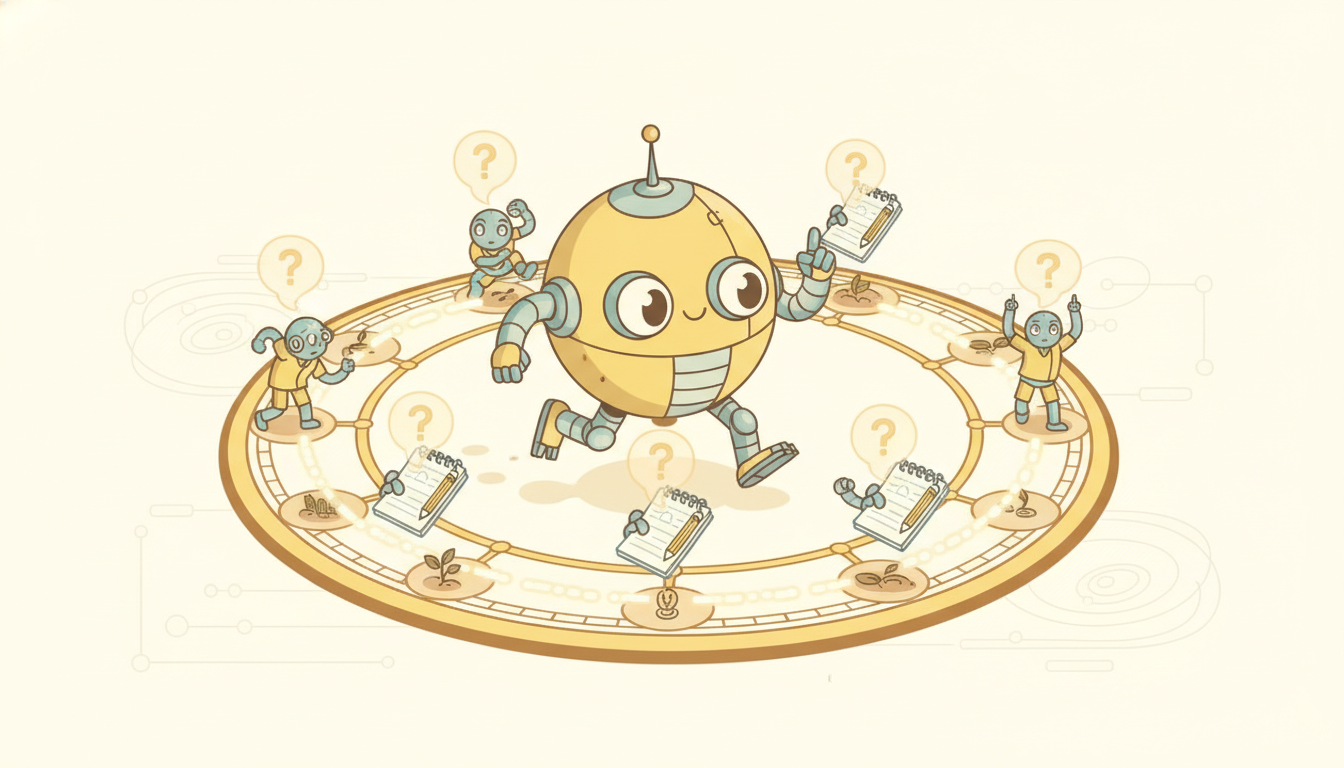
1. What a Temporal AI Agent Is: The Loop, Running Beginner
A temporal AI agent is a system that runs a perceive-reason-decide-act loop over time. Read slowly, that sentence has four verbs and one preposition, and every word is load-bearing. Perceive: at each step the agent takes in an observation $o_t$ of its environment. Reason: it updates an internal state $s_t$ that summarizes what it has seen and inferred. Decide: it chooses an action $a_t$ from $s_t$ according to a policy. Act: it executes $a_t$, changing the environment. And over time: the whole thing repeats, the environment returns a new observation $o_{t+1}$, and the state $s_t$ carries forward, so the agent is not a function evaluated once but a process unfolding across a horizon. That carried state, the thing that survives from one step to the next, is what makes an agent temporal rather than a stateless input-output map.
This is not a new loop. It is exactly the loop Section 1.3 placed at the foundation of the entire book, where we argued that intelligence becomes temporal precisely when a system must perceive a stream, maintain belief across time, and act with consequences that feed back. There we drew it as a diagram and promised a running implementation in Part VII; an agent is that implementation. And it is the same loop, viewed from the decision side, that Chapter 22 formalized as the agent-environment interaction of a Markov decision process. The MDP gave us the mathematics of the loop, transition kernel, reward, policy, value, and discount. An agent architecture gives us the software of the loop, the modules and the control flow that turn $\pi$ from a table into a program. The agent is the synthesis: the perception-and-reasoning machinery of Parts I through V supplies the state $s_t$; the policy-and-value machinery of Part VI supplies the action $a_t$; the architecture wires them into one cycle.
The single structural fact that separates an agent from a forecaster is the feedback edge, the orange path in Figure 31.1.1. A forecaster reads a series and emits a prediction; nothing it outputs comes back as input. An agent's action enters the world and the world's response becomes the agent's next observation, so the agent is coupled to its own consequences. This closure is the source of everything that is hard and everything that is powerful about agents. It is powerful because the agent can steer the future toward its goal rather than merely predict it. It is hard because the agent can also steer the future into a state its perception misreads, then act on that misreading, and there is no external supervisor in the loop to catch the drift. We unpack both the power and the hazard in the sections that follow.
The recurring claim of this book is that each classical idea returns in learned form, and that all of them are instances of one temporal loop. Here is where the thread ties off. The Kalman filter of Chapter 7 was the loop with $f$ and $g$ fixed by a model; the RNN of Chapter 10 was the loop with $f$ and $g$ learned; the MDP of Chapter 22 was the loop with a reward and a chosen action; the world model of Chapter 29 was the loop run forward in imagination. A temporal AI agent is the loop assembled into a running system, with a perception that may be any model from Parts I through V and a policy that may be any decision rule from Part VI. The book has been building this agent in pieces for thirty chapters; this chapter snaps the pieces together and turns the loop on.
2. Architecture Families: Reactive, Deliberative, Hybrid Intermediate
The loop of subsection one admits many implementations, and the history of AI is in large part a history of arguments about how much reasoning should sit between perception and action. Three families recur, and the modern LLM agent inherits from all of them, so it pays to name them precisely. At one extreme is the reactive agent, which maps observation to action with little or no internal deliberation: $a_t = \pi(o_t)$, a fast reflex. At the other is the deliberative agent, which builds an internal model of the world and plans over it before acting: it senses, constructs a representation, searches for a plan, then executes, the classic sense-plan-act pipeline of early symbolic robotics. In between sits the hybrid agent, which keeps fast reactive behaviors for the moment-to-moment while a slower deliberative layer sets goals and revises plans, the architecture that actually drives most real systems.
The reactive tradition's sharpest expression is Brooks's subsumption architecture from 1980s robotics, which discarded the central world model entirely and layered simple behaviors (avoid-obstacle, wander, explore) so that higher layers subsume lower ones (a higher behavior can suppress or override the output of a lower one, so obstacle-avoidance can veto wander), producing competent behavior with almost no representation. The deliberative tradition's sharpest expression is the sense-plan-act robot that builds a map, plans a path, and executes it, powerful when the world is well modeled and slow when it is not. Reinforcement learning, the whole of Part VI, produces agents that are mostly reactive at deployment: a trained policy $\pi(a \mid s)$ is a fast mapping from state to action distribution, the deliberation having been amortized into the weights during training. And the LLM-based agent, the subject of the rest of this chapter, is hybrid by construction: the language model is a fast reactive next-token policy, but wrapped in a loop that lets it reason in natural language and call tools, it deliberates. The line of work that opened this door is ReAct (Yao et al., 2022), which interleaves reasoning traces and actions so the model thinks in words, acts with a tool, observes the result, and thinks again.
| Family | Loop body | Strength | Weakness | Canonical example |
|---|---|---|---|---|
| Reactive | $a_t = \pi(o_t)$, reflex, no plan | fast, robust, cheap | no foresight, no long-horizon goals | subsumption robot; trained RL policy |
| Deliberative | sense, build model, plan, execute | foresight, goal-directed | slow, brittle if the model is wrong | sense-plan-act path planner |
| Hybrid | fast reactive layer plus slow planning layer | responsive and goal-directed | complex to coordinate the two layers | ReAct LLM agent; layered robot control |
The loop body of any of these families can be written as a single piece of pseudocode, and writing it once makes the family differences sharp. The agent maintains a state, repeatedly perceives, updates, decides, and acts, until a goal or budget halts it:
$$\begin{aligned} &s \leftarrow s_0 \\ &\textbf{repeat} \\ &\quad o \leftarrow \textsc{Perceive}(\text{env}) \\ &\quad s \leftarrow \textsc{UpdateState}(s, o) \qquad \text{(reasoning: fold observation into state)} \\ &\quad a \leftarrow \pi(s) \qquad\qquad\;\;\, \text{(decision: reactive reflex, or a planned action)} \\ &\quad \textsc{Execute}(a, \text{env}) \\ &\textbf{until } \textsc{GoalMet}(s) \textbf{ or } \text{budget exhausted} \end{aligned}$$The families differ only in two slots. A reactive agent makes UpdateState trivial (the state is just the latest observation) and $\pi$ a fast learned or hand-coded reflex. A deliberative agent makes UpdateState build a rich world model and $\pi$ an explicit planner that searches that model, the planning of Section 31.3. A hybrid agent runs a fast $\pi$ inside the loop while a slower process intermittently revises the goal or the plan. Everything elaborate in agent design, the memory of Section 31.2, the planners of Section 31.3, the tool interfaces, is an elaboration of those two slots inside this one skeleton.
Reactive, deliberative, and hybrid are not three different loops; they are one loop with a dial. The dial controls how much computation happens in the gap between perceiving an observation and emitting an action. Turn it to zero and you have a reflex, the reactive agent, fast and shallow. Turn it up and you insert world-model construction and search, the deliberative agent, slow and far-sighted. The hybrid keeps the dial low for the inner loop and spins it up occasionally for replanning. Reading any agent, classical robot or LLM system, reduces to one question: how much reasoning lives between perceive and act, and is it the same amount every step or does it vary? That single question places the agent on the spectrum and predicts both its responsiveness and its failure modes.
3. The Modern LLM-Agent Stack: Policy, Memory, Planning, Tools Intermediate
The agent architecture that dominates practice in 2026 has a recognizable four-part anatomy, and each part maps onto a slot of the loop from subsection two. At the center is a policy core, almost always a large language model, which plays the role of $\pi$: given the current state rendered as text, it produces the next thought or action. Around that core sit three faculties that turn a stateless next-token predictor into a temporal agent. Memory supplies state that persists beyond the model's context window, the subject of Section 31.2. Planning supplies the deliberative layer that decomposes a goal into steps, the subject of Section 31.3. And tools supply the action interface, the means by which the agent's decisions actually touch the world: a search API, a calculator, a code interpreter, a database query.
A bare language model is a poor agent on its own. It is a stateless function: it maps a context to a next token and forgets everything the instant the context scrolls past. It cannot persist a fact across a long task (no memory), it cannot reliably hold a multi-step plan in its head while executing it (no planning scaffold), and it cannot do anything but emit text (no tools). The agent stack is the set of structures that repair each deficit: memory makes it stateful, planning makes it deliberative, tools make it effective. Figure 31.1.2 draws the stack and labels which loop slot each faculty serves.
The temporal dimension is what distinguishes a temporal agent from a one-shot question answerer, and it shows up in two distinctions worth naming. First, the agent's state evolves over time: the context the LLM sees at step $t$ is a function of everything that happened in steps $1$ through $t-1$, mediated by memory. A temporal agent is, formally, a policy over histories, $a_t = \pi(o_{1:t}, a_{1:t-1})$, and memory is the mechanism that compresses that growing history into a bounded state, exactly the role the hidden state played for the RNN in Chapter 10 and the belief state played for the POMDP agent in Chapter 23. Second, agents run in one of two temporal regimes: episodic, where each task is a self-contained episode that resets the state at the end (answer this question, then forget), and continuing, where the agent persists indefinitely and its state accumulates across tasks (a long-running assistant or monitoring agent). The episodic-versus-continuing distinction, first met for MDPs in Chapter 22, decides how memory must behave: an episodic agent can clear memory at episode end, a continuing agent must manage memory growth forever, the central design pressure of Section 31.2.
The most common conceptual error in agent design is to conflate the language model with the agent. The LLM is one component, the policy core, a fast reactive map from context to next token. By itself it is stateless, plan-less, and effect-less. The agent is the loop plus the three faculties that wrap the core: memory to give it state across time, planning to give it foresight, tools to give it reach into the world. Swap the LLM for a different model and you have changed the policy; remove the memory and you have an amnesiac that re-derives everything each step; remove the tools and you have a model that can only talk. Designing an agent is designing the wrapper, the loop and the three faculties, at least as much as it is choosing the core. The chapters that follow take the faculties one at a time.
4. Failure Modes: Loops, Drift, and Statefulness Bugs Advanced
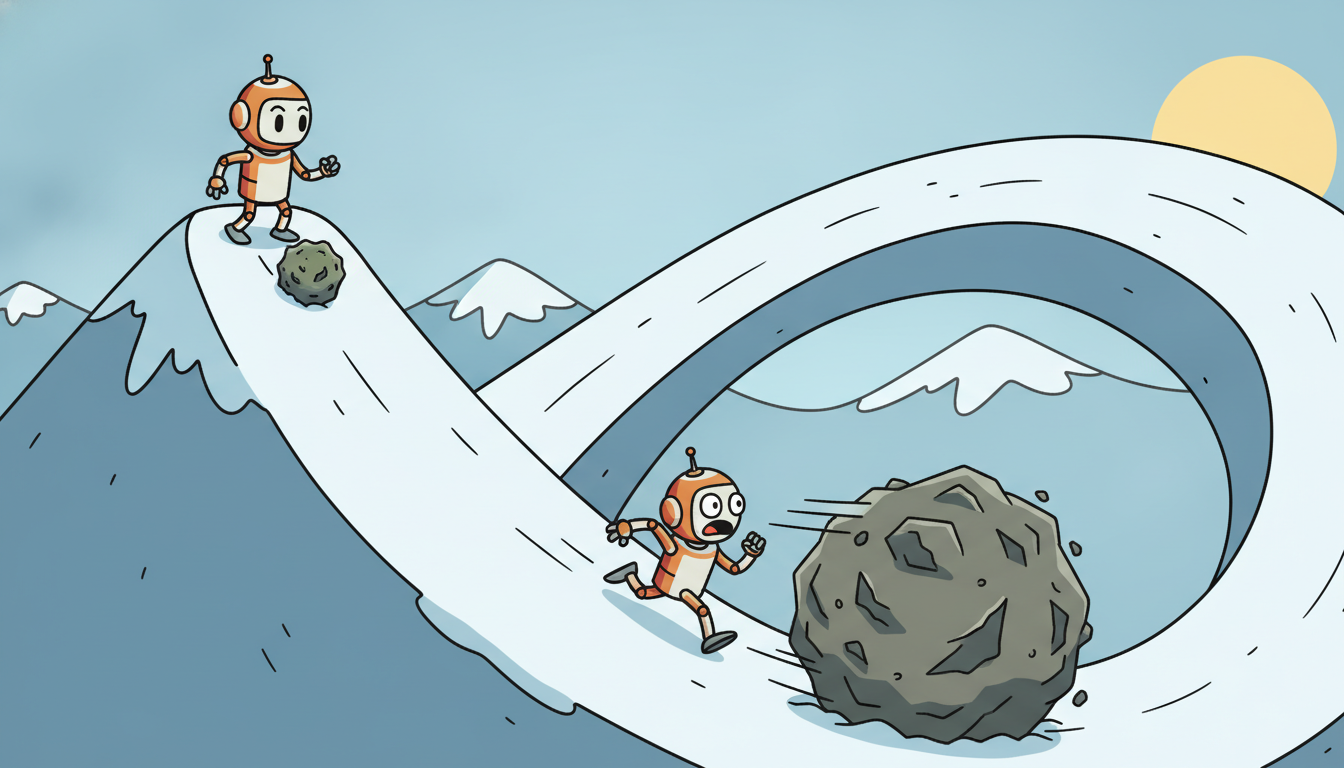
Closing the loop creates failure modes that no open-loop model has, and a working knowledge of them is what separates an agent that ships from one that quietly burns its budget. Three dominate. The first is the infinite loop: an agent with no reliable stopping condition, or one whose goal-check never fires, perceives and acts forever, repeating the same action or oscillating between two, accomplishing nothing while consuming tokens or actuator cycles. The epigraph's six-hour afternoon is this failure. It arises because the loop of subsection one terminates on GoalMet(s) or a budget, and if the goal is mis-specified, never satisfiable, or never detected, only the budget saves you, and an agent without a hard budget cap has no floor.
The second failure is error accumulation over long horizons, the agent-specific form of the compounding error we first met for autoregressive forecasters in Chapter 5 and for imitation learning in Chapter 27. Because the agent feeds its own actions back into its own observations, a small mistake at step $t$ shifts the state it observes at step $t+1$ into territory it handles slightly worse, producing a larger mistake at $t+2$, and so on. The errors are not independent; they correlate and compound. If each step has even a modest probability $p$ of a consequential error and errors are roughly absorbing (one bad step tends to beget another), the probability that an $H$-step rollout stays on track falls off geometrically, $(1-p)^H$, so long horizons are intrinsically fragile. This is why agent reliability is so much harder than single-call reliability: a model that is right 95 percent of the time per step is right end-to-end on a twenty-step task only about a third of the time.
Suppose each step of an agent succeeds independently with probability $1 - p$, and the whole task succeeds only if every step does. With a per-step failure probability of $p = 0.02$ (the agent picks the wrong tool or mis-reads an observation two percent of the time), the success probability of an $H$-step task is $(1 - p)^H = 0.98^H$. For a short $H = 5$ task this is $0.98^5 \approx 0.904$, a comfortable 90 percent. For $H = 20$ it is $0.98^{20} \approx 0.668$, already only two in three. For $H = 50$ it is $0.98^{50} \approx 0.364$, barely better than a coin flip, and for $H = 100$ it is $0.98^{100} \approx 0.133$, a near-certain failure. The lesson in one line: end-to-end reliability decays exponentially in horizon length, so halving the per-step error rate (to $p = 0.01$, giving $0.99^{100} \approx 0.366$) buys far more on long tasks than on short ones. This is the quantitative reason agent designers obsess over per-step accuracy, verification, and recovery: the horizon is an exponential amplifier.
The third failure is the statefulness bug, the quiet one. Because an agent carries state across steps, a defect in how that state is updated, a memory that is appended to but never cleared, a stale observation that lingers, a variable shared across episodes that should have reset, corrupts not one step but every subsequent step, and the symptom appears far from the cause. An episodic agent that forgets to reset its memory at episode boundaries leaks context from one task into the next; a continuing agent whose memory grows without bound eventually blows its context window and silently drops the early state. These bugs are insidious precisely because the loop hides them: the same code runs every step, so a fault that depends on accumulated state only manifests after enough steps, and reproducing it requires replaying the whole history. The discipline that prevents them is to make state transitions explicit and to test the agent over long rollouts, not single steps.
A folk hazard of early tool-using agents: an agent told to "book a flight" calls the booking tool, does not correctly perceive that the booking succeeded (the confirmation came back in a format its observation parser ignored), concludes the task is not yet done, and books again. And again. The infinite loop and the perception bug shake hands: the stopping condition depended on observing success, the success was real but invisible to the agent, so the goal-check never fired and the budget was the only thing standing between the user and forty identical itineraries. The fix is unglamorous and universal: a hard step budget, an idempotent or confirm-before-repeat tool, and a goal-check that does not depend on the agent's own possibly-wrong reading of the world. The loop will run as long as you let it; bound it.
The architecture question, how to structure the loop so it stays reliable over long horizons, is among the most active in applied AI. Reflective and self-correcting loops extend bare ReAct (Yao et al., 2022) with an explicit critique step: Reflexion (Shinn et al., 2023) has the agent verbalize what went wrong and store the lesson in memory, and tree-of-thoughts and language-agent tree search wrap the loop in deliberate search over reasoning branches. On the engineering side, graph-structured agent frameworks (LangGraph, 2024) make the loop an explicit state machine with typed nodes and edges, so the control flow that subsection two wrote as pseudocode becomes an inspectable, checkpointable graph, which directly attacks the statefulness bugs of this subsection. Multi-agent orchestration (AutoGen, CrewAI, and the 2024 to 2025 wave of role-specialized agent teams) decomposes a task across cooperating agents, trading single-agent simplicity for division of labor. And a growing benchmark literature (AgentBench, tau-bench, SWE-bench for coding agents, 2024 onward) has made long-horizon reliability measurable, turning the exponential-decay argument of the numeric example above from a worry into a tracked metric. The 2026 consensus: the policy core keeps improving, but the durable engineering gains come from the loop structure, the memory of Section 31.2, and the planning of Section 31.3 that surround it.
5. Worked Example: A Minimal ReAct Agent, From Scratch and From a Library Advanced
We now make the loop executable. The plan mirrors the rest of the book: build a minimal ReAct-style agent from scratch so every part of the loop is visible, run it on a toy task, then collapse the same agent into a library skeleton and state the line-count reduction. The toy task is deliberately tiny so the loop, not the task, is the lesson: the agent must answer a multi-step arithmetic-and-lookup question that it cannot answer in one shot, forcing it to reason, act with a tool, observe, and reason again. Code 31.1.1 is the from-scratch agent: a perceive-think-act loop with two tools and a hard step budget, with a tiny rule-based stand-in for the LLM policy so the example runs with no API key and is fully deterministic.
import re

# Two tools the agent can call. Each maps a string argument to a string observation.
def calc(expr):
    """A calculator tool: evaluate a simple arithmetic expression."""
    try:
        return str(eval(expr, {"__builtins__": {}}, {}))   # sandboxed eval, digits/ops only
    except Exception as e:
        return f"error: {e}"

POPULATION = {"france": 68, "germany": 84, "spain": 48}    # millions, a lookup "database"
def lookup(country):
    """A retrieval tool: look up a country's population in millions."""
    return str(POPULATION.get(country.strip().lower(), "unknown"))

TOOLS = {"calc": calc, "lookup": lookup}

def policy(observation, scratchpad):
    """Stand-in for an LLM: given the running scratchpad, emit the next Thought+Action.
    A real agent calls an LLM here; we hand-code the reasoning so the loop is deterministic."""
    text = scratchpad.lower()
    if "lookup[france]" not in text:                       # step 1: get France's population
        return "Thought: I need France's population.\nAction: lookup[France]"
    if "lookup[germany]" not in text:                      # step 2: get Germany's population
        return "Thought: Now I need Germany's population.\nAction: lookup[Germany]"
    if "calc[" not in text:                                # step 3: add the two values
        nums = re.findall(r"Observation: (\d+)", scratchpad)
        return f"Thought: I will add them.\nAction: calc[{nums[0]}+{nums[1]}]"
    total = re.findall(r"Observation: (\d+)", scratchpad)[-1]   # step 4: report the answer
    return f"Thought: I have the total.\nFinish: {total} million"

def react_agent(question, max_steps=8):
    """A minimal ReAct loop: observe -> think -> act with a tool -> observe, until Finish."""
    scratchpad = f"Question: {question}\n"
    for step in range(max_steps):                          # the HARD step budget bounds the loop
        out = policy(None, scratchpad)                     # reason: LLM proposes Thought+Action
        scratchpad += out + "\n"
        if out.startswith("Thought") and "Finish:" in out:  # decision to stop
            return out.split("Finish:")[1].strip(), step + 1, scratchpad
        m = re.search(r"Action: (\w+)\[(.*?)\]", out)      # parse the chosen tool call
        if not m:
            return "no action parsed", step + 1, scratchpad
        tool, arg = m.group(1), m.group(2)
        obs = TOOLS[tool](arg)                             # act: run the tool in the world
        scratchpad += f"Observation: {obs}\n"              # perceive: fold the result back in
    return "step budget exhausted", max_steps, scratchpad  # the loop NEVER runs unbounded

answer, steps, trace = react_agent("What is the combined population of France and Germany?")
print(f"answer = {answer}   (solved in {steps} reasoning steps)")
policy reasons and proposes an action, the regex parse and TOOLS[tool](arg) act, the appended Observation perceives, and the scratchpad is the carried state. The max_steps budget is the hard floor that prevents the infinite loop of subsection four; nothing here can run forever.answer = 152 million (solved in 4 reasoning steps)
To make the reactive baseline concrete and motivate the numeric comparison, Code 31.1.2 is a one-shot reactive agent that maps the question straight to an answer with no loop and no tools. On a task that needs composition, it has no mechanism to retrieve and combine, so it fails; the contrast is the point.
def reactive_agent(question):
    """A purely reactive baseline: one observation in, one action out, no loop, no tools."""
    # With no tool-use loop, a reflex policy can only answer from what it already knows.
    # The composite question requires two lookups and an addition it cannot perform in one shot.
    return "I cannot compute that in a single step", 1     # 1 "step", and it is wrong

ans_r, steps_r = reactive_agent("What is the combined population of France and Germany?")
print(f"reactive baseline: {ans_r}   (steps = {steps_r}, correct = False)")
print(f"react agent:       152 million   (steps = {steps}, correct = True)")
print(f"steps-to-solve: reactive never solves; react solves in {steps} steps")
reactive baseline: I cannot compute that in a single step   (steps = 1, correct = False)
react agent:       152 million   (steps = 4, correct = True)
steps-to-solve: reactive never solves; react solves in 4 steps
Count what each agent spent. The reactive baseline took exactly one step and produced a wrong answer, so its steps-to-solve is undefined (it never solves). The ReAct agent took four reasoning steps: two lookup calls, one calc call, and one Finish, each step adding one Thought-Action-Observation triple to the scratchpad. The loop therefore cost a factor of four more model calls than a single reflex, and that fourfold cost is the price of decomposition: the task has three irreducible sub-operations (retrieve France, retrieve Germany, add), and a loop is the only structure that can sequence them while carrying intermediate results in state. The general law: steps-to-solve scales with the depth of the task's dependency chain, and the loop converts an unsolvable single-shot problem into a solvable multi-step one at a cost linear in that depth. For an eight-step task the ReAct agent would take roughly eight steps and the reactive baseline would still take one, and still fail.
Now the library pair. A production framework supplies the loop, the tool-dispatch, the scratchpad management, the step budget, and the stopping logic, so the same agent reduces to declaring the tools and the goal. Code 31.1.3 is a library-style skeleton in the shape used by LangGraph, LlamaIndex, and AutoGen: register tools, hand the framework an LLM, and call run.
# Library skeleton (LangGraph / LlamaIndex / AutoGen-style). Pseudocode-level API.
from agent_framework import Agent, tool          # any modern agent framework

@tool
def lookup(country: str) -> str:
    "Look up a country's population in millions."
    return str({"france": 68, "germany": 84, "spain": 48}.get(country.lower(), "unknown"))

@tool
def calc(expr: str) -> str:
    "Evaluate a simple arithmetic expression."
    return str(eval(expr, {"__builtins__": {}}, {}))

agent = Agent(llm="your-model", tools=[lookup, calc], max_steps=8)   # the loop is built in
answer = agent.run("What is the combined population of France and Germany?")
print(answer)        # -> "152 million"; the framework ran the ReAct loop internally
Agent(...).run(...) call; the framework supplies the loop, the ReAct prompt, and the stopping logic internally.The line-count reduction tells the story of the abstraction. The from-scratch agent of Code 31.1.1 was roughly 45 lines: the loop, the scratchpad, the action parser, the tool table, the budget, and a hand-coded policy. The library skeleton of Code 31.1.3 is about 12 lines, a better than three-to-one reduction, and the lines that vanished are exactly the loop machinery, the tool-dispatch, and the stopping logic that every agent needs and no one should rewrite. What the framework handles internally is precisely the content of this section: the loop of subsection one, the hybrid reason-act control flow of subsection two, the tool interface of subsection three, and crucially the step budget and termination of subsection four. Reading the from-scratch version first is what lets you debug the library version when its hidden loop misbehaves, because the failure modes of subsection four live inside that hidden loop.
The hand-built perceive-think-act loop of Code 31.1.1 ran about 45 lines of loop, parser, scratchpad, and budget bookkeeping. Modern agent frameworks (LangGraph, LlamaIndex, AutoGen, and the OpenAI and Anthropic agent SDKs) collapse that to a tool registration and a single run call, a better than three-to-one reduction, and they add for free what the from-scratch version omitted: streaming, retries, structured tool schemas, observability, checkpointing of the loop state, and graph-structured control flow. What they handle internally is the ReAct loop itself, the same observe-think-act-observe cycle written here by hand, plus the step budget and termination logic that keep it from looping forever. The right tool here is a framework; the reason to build it once from scratch is that when the hidden loop misbehaves, the failure modes of subsection four are exactly what you will be debugging.
Step back and read what the code establishes together. Code 31.1.1 made the four-verb loop of subsection one literal and bounded it with the step budget that prevents subsection four's infinite loop. Code 31.1.2 showed the reactive baseline failing the same task for lack of a loop, quantifying what deliberation buys. Code 31.1.3 collapsed the whole thing into a library call, exposing the loop as exactly the machinery a framework provides. The payoff is that an agent is not a black box: it is the loop of Figure 31.1.1, you can write it by hand, a framework writes it for you, and its reliability is governed by the step budget, the memory of Section 31.2, and the planning of Section 31.3 that the rest of this chapter builds.
Who: A platform team at a healthcare-software company building an agent to triage incoming clinical-support tickets, routing each to the right specialist queue using a lookup tool over an internal knowledge base and a classification tool, the healthcare series threaded through Chapter 35.
Situation: The agent was an LLM core wrapped in a ReAct loop with two tools, exactly the shape of Code 31.1.1, deployed as a continuing agent that processed tickets around the clock without resetting between them.
Problem: In production a fraction of tickets sent the agent into a loop: it would classify, decide the classification was low-confidence, re-classify, decide again, and never finish, burning thousands of model calls on a single ticket while the queue backed up. A second, subtler fault appeared after a day of running: classifications began bleeding across tickets, as if the agent remembered the previous patient.
Dilemma: The team could cap the loop hard and risk cutting off genuinely hard tickets mid-reasoning, or raise the confidence bar and risk endless re-classification, or rebuild the agent as episodic and lose the cross-ticket context that occasionally helped. None was obviously right.
Decision: They diagnosed two of subsection four's failure modes at once. The infinite loop came from a goal-check (confidence > threshold) that some tickets could never satisfy; the cross-ticket bleed was a statefulness bug, a scratchpad that was appended to but never cleared between tickets in the continuing loop. They imposed a hard step budget per ticket (escalate to a human on exhaustion rather than loop), made the loop episodic per ticket with an explicit memory reset at each ticket boundary, and kept a separate, bounded long-term memory for genuinely reusable knowledge.
How: The fix was structural, not a better prompt: a max_steps cap that routed to a human queue on exhaustion (the budget floor of Code 31.1.1), a per-ticket state reset that closed the leak (the episodic discipline of subsection three), and a goal-check that no longer depended solely on the agent's own confidence estimate.
Result: Looping tickets dropped to near zero, the cross-ticket bleed disappeared, and the human-escalation path turned the worst case from an infinite cost into a bounded one. The agent processed the easy majority autonomously and handed the hard minority to a person, which was the intended behavior all along.
Lesson: The two most common agent failures, the loop that will not stop and the state that will not reset, are architectural, not model-quality, problems. A hard step budget and an explicit, deliberate state-reset policy at episode boundaries prevent both, and they must be designed in from the start because, as subsection four warned, the loop hides these faults until enough steps have accumulated to reveal them.
Exercises
Three exercises, one of each type. Solutions to selected exercises appear in Appendix G.
For each of the following, state whether it is best described as reactive, deliberative, or hybrid, and justify your placement by identifying how much reasoning sits between perceiving and acting (the dial of subsection two): (a) a thermostat that turns heating on when temperature drops below a setpoint; (b) a chess engine that searches a game tree before each move; (c) a ReAct LLM agent that thinks in natural language, calls tools, and occasionally replans; (d) a trained deep-RL policy from Chapter 25 deployed without further search. Then explain why a trained RL policy is reactive at deployment even though its training involved extensive deliberation.
Extend the from-scratch agent of Code 31.1.1 to detect and break the infinite loop of subsection four. Add a guard that halts the loop if the agent proposes the same action (same tool and same argument) twice in a row, returning a "stuck: repeated action" result instead of continuing. Test it by writing a deliberately broken policy that always returns Action: lookup[France], and confirm your guard stops it within two steps rather than running to the max_steps budget. Then argue why a same-action guard is weaker than a true goal-check: give a looping pattern (oscillating between two distinct actions) that your guard does not catch, and sketch how you would detect it.
The triage agent in the practical example failed because a continuing agent leaked state across tickets. Design a memory-reset policy for an agent that must be mostly episodic (reset per task) but should retain a small amount of genuinely reusable knowledge across tasks (for example, a corrected classification rule learned from a human escalation). Specify precisely what gets cleared at each episode boundary and what persists, how you bound the growth of the persistent store so a continuing agent does not eventually overflow its context (forward-reference the mechanisms of Section 31.2), and how you would test, over a long multi-episode rollout, that no task-specific state bleeds into the persistent store. Discuss the trade-off between aggressive resetting (safe but forgetful) and generous retention (capable but leak-prone).